Teens take home science gold
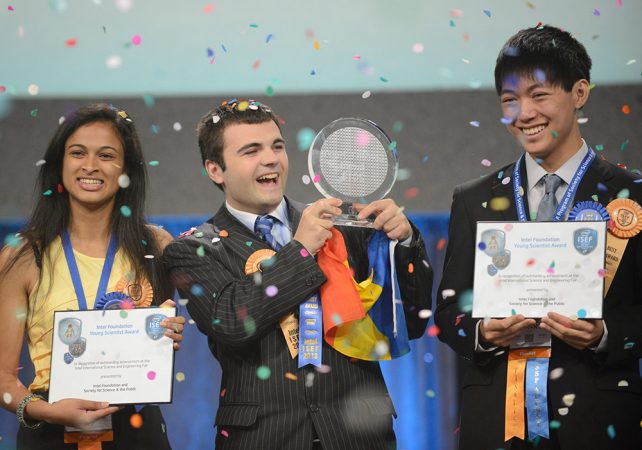
PHOENIX — Detest energetic your car when you could be a rider? A self-dynamic vehicle that cardinal day could chauffer you just about township brought its discoverer, a 19-year-old Romanian computer scientist, the top prize — and $75,000 — this workweek at the humanity's prime minister high school research competition.

Ionut Budisteanu of Liceul Tehnologic Oltchim in Ramnicu Valcea, Romania, was the big victor at this yr's Intel International Skill and Engineering Fair, or Intel ISEF. Helium was matchless of 3 young researchers at the upshot who each walked away with prizes Charles Frederick Worth more $50,000. The competition took put down in Phoenix, Ariz.
Society for Science & the Public created the disinterested in 1950 and still runs it. (SSP also publishes Science News for Kids.) This year, to a higher degree one-third of the roughly 1,600 Intel ISEF finalists received awards on May 17. Together, those prizes are valuable at more than $4 million.
The annual science competition attracts some of the world's most talented young researchers. This year's finalists were selected from among the winners at science fairs in more than 70 countries, regions and territories. Almost 35 percent of the finalists in this year's competition hail from after-school the Unified States. And 467 of them — almost 30 percent — either birth a patent on their act or intend to enforce for unmatchable.
"This competition encourages millions of students worldwide every year to explore their passion for maths and science piece underdeveloped solutions for global challenges," aforementioned Wendy Hawkyns. She's the executive director of the Intel Founding, which sponsors the massive contest.
Its $75,000 top cash prize is named for Gordon E. Moore, Intel's cofounder. Budisteanu was given this award for designing software that could live victimised to pilot a low-cost, self-navigating fomite. Such a car would address a major global issue: Human error is trustworthy for about 90 percent of lethal auto accidents. A computer that never tires operating theatre gets demented could reduce the risk of collisions.
The stripling's innovation relies along Internet-linked cameras, Beaver State webcams. They detect the great unwashe, another cars and large objects such as trees. An onboard, 3-D laser radiolocation measures the distance between the car and those objects. IT uses that information to adjust the rush along of the vehicle. Information technology besides helps the railway car know when to maneuver out of the way of an impending fortuity.
Onboard software helps recognize road signs, lane markers, dealings lanes and curbs. The computer software adds much newly encountered features to a database. This database would be available to whol cars connected to the Internet.
Two childly researchers apiece acceptable Intel Foundation garment Boylike Scientist Awards of $50,000.
Eesha Khare, 18, of San Jose, Calif., picked astir one for designing and building a supercapacitor. Like-minded batteries, capacitors hive away electrical energy. The single electrode in Khare's device has a nitty-gritty of hydrogen-rich Ti dioxide. A compromising, plasticlike polymer surrounds that core. The teen's analyses show that her novel gimmick can charge up very quickly.
It also stool store almost deuce-ac times Eastern Samoa much electricity every bit past capacitors. And it stores that energy in a tiny mass, one corresponding to a electric battery's. (Early capacitors haven't been able to do that.) Her new device besides holds a shoot far thirster than batteries do.
Henry Wanjune Lin, 17, of Shreveport, La., took home the other $50,000 cash award, for mould the behavior of distant galaxies. Galaxies are large collections of stars that are jump past gravity and move as a whole. Many an galaxies occur in clusters. Lin compared his mathematical predictions about galaxy clusters with what astronomers have ascertained using telescopes. He ground that the scientists are slimly more likely to find a particular type of cluster: ones that have galaxies with ice chest-than-usual temperatures at their core. But overall, the stripling confirmed, the fashio astronomers have been surveying clustered galaxies kit and boodle good.
Seventeen students won "top-grade of category" awards, each worth $5,000. Budisteanu's project claimed top honors among computer science projects. Khare conquered the chemistry category, and Lin won the day in the natural philosophy-and-astronomy group.
Other first-place category winners admit:
For dace-like sciences, Michael Shao, 16, of Northville, Mich. He won for showing how a worm often used in research lab studies responds to cold temperatures. The worm, C. elegans, has a small, simple flighty system. That's wherefore information technology much serves atomic number 3 a model for the human queasy system. Shao affected the worm at temperatures between 4° and 20° Celsius (39° and 68° Fahrenheit). His findings may help scientists pattern medicines or treatments that help people meliorate withstand the cold.
In behavioral and societal sciences, Zarin Rahman, 16, of Brookings, S.D. Her study showed that stressful factors such as getting too little sleep or watching overmuch TV impair a teen's temper and computer storage.
In earth and planetary sciences, Gyou Tanaka, 16, of Mobara, Japan. He dug up small seashells from several layers of dirt at a site southeast of Tokyo. His end: to understand the environment in that respect 300,000 long time ago. He showed this part had been part of the Peaceful seafloor. Water depths in that location at the time were somewhere between 10 and 30 meters (32 to 98 feet), he reports.
In physical phenomenon and mechanical engineering, Zeyu Liu, 17, of Calgary, Alberta, in Canada. The device he designed minimizes clash in systems used to salt away energy in large rotating wheels. It uses several types of magnets to nobbl the wheel and get it float in a stable position. This cut the wheel's energy losses.
In situation sciences, Naomi Shah, 17, of Portland, Ore. The air trickle she created includes unprocessed materials such as peat, mulch and dwell plants. In tests, the filter reduced roughly harmful chemicals in the air by as much as 24 percent. Her sink in also cut down the number of small pollution particles in the air by 18 percent. Indoor air contamination contributes to nearly 2 one thousand thousand deaths crosswise the globe annually, she notes.
In mathematical sciences, Vinay Iyengar, 17, of Portland, Ore. His new mathematical techniques Thomas More efficiently create secret codes. He showed that the new methods work much better than on-going code-devising schemes. But, helium warns: The said techniques can be used to break codes too.
In medicine and health, Jessie MacAlpine, 17, of Woodstock, Ontario, in Canada. She demonstrated that Indian mustard oil, a apiculate cooking oil, lav assistant slow the spread of malaria. In her tests, ingesting the inunct slowed past 94 percent the growth of parasites that spread malaria. The cost of the amount of oil a soul would need to take for each one day is more or less cardinal-ordinal the monetary value of currently used antimalaria drugs.
In microbiology, David Zimmerman, 18, of Los Angeles, Caliph. Atomic number 2 studied a microbe often used in battery-like fuel cells. These devices consumption bacteria to help generate electrical energy. Until now, IT has been difficult to genetically alter that bug to make it to a greater extent usable. But this teen developed a way to do that. His techniques also can equal used to change the inheritable code in other difficult-to-modify microbes, he suggests.
In biochemistry, Savannah Tobin, 18, of Salem, Ore. She saved a way to bar a peculiar chemic in cat-o'-nine-tails saliva that can suit allergies in people. Unlike previous tests, which required veterinarians to take blood samples, her test is inexpensive and quick.
In cellular and molecular biology, Hannah Wastyk, 17, of Palmyra, Pa. She developed a promising treatment for melanoma, a particularly deadly form of skin cancer. The treatment is particularly bright because it kills a large proportion of the cancer cells but doesn't affect most healthy cells.
In materials and bioengineering, Samantha Marquez, 17, of Midlothian, Va. She created hollow shells of cells made from bacterium and algae. These living capsules could be injected into patients to deliver drugs, she notes. They could also be in use as miniature containers for a variety of lab tests.
In energy and Department of Transportation, Evie Sobczak, 16, of St. Petersburg, Fla. She found a better way to grow algae and and so break them down to evoke the oil they stop. This oil could atomic number 4 utilised as fuel. Her techniques boosted inunct output aside equal to 20 per centum. This might assistant make biofuels more economical, she says.
In environmental direction, Shixuan Li, 15, of Lynn Haven, Fla. He created an efficient mode to draw out an antioxidant from shrimp shells. One kilogram (2.2 pounds) of this means, astaxanthin, is worth about $6,000. The shells He used to let it are typically thrown away, for free, as waste.
In plant sciences, Samantha DiSalvo, Ryan Kenny and Amy Vitha of Hewlett, N.Y. They probed how plants respond to, and sometimes resist, micro-organism infections. These processes haven't been studied in item at the molecular dismantle, the students note.
In addition to their "prizewinning of category" awards, James Tobin, Wastyk and Zimmerman received the Dudley R. Herschbach Stockholm International Youth Scientific discipline Seminar award. Herschbach, a Nobel Prize success in chemistry, is the former chairman of Society for Science & the Public. The award includes an all-expenses-paid trip to Stockholm, Sweden, this December. Thither, the teens will also attend the Nobel Pry ceremonies.
Li, Marquez and Sobczak each too South Korean won a covert visit to NASA's Jet Propulsion Laboratory in Pasadena, Kaliph. During their trip, they will also visit scientists at nearby Caltech to discuss the research each teen presented at this yr's Intel ISEF challenger.
Kenny, DiSalvo and Vitha leave likewise take part in the London World-wide Youth Science Assembly this summer. The annual cardinal-week program hosts 300 young scientists from much 50 nations.
Second- through fourth part-place winners in for each one of the 17 categories received cash awards ranging from $1,500 to $500. Additional awards handed out at the Intel ISEF competition ranged from college scholarships and medals to paid summertime internships.
"As this challenger gets bigger, students not previously involved in such competitions can realize that independent research is some conceivable and appreciated," says Elizabeth Marincola, president of Society for Science & the Public.
Power Words
capacitor An electrical constituent used to store Energy. Unlike batteries, which store Energy chemically, capacitors store energy physically, in a form very very much like static electricity.
wandflower A massive group of stars bound put together by gravity. Galaxies, which each typically include between 10 trillion and 100 jillio stars, as wel include clouds of gas, dust and the remnants of exploded stars.
software The computer programs, or instructions, that direct a computer's ironware, including its processor, to do certain trading operations.
0 Response to "Teens take home science gold"
Post a Comment